Veterinary Technologist and Technician Salary in Martinsburg, WV: $40,844 (2026)
Quick Answer:A full-time veterinary technologist and technician in Martinsburg, WV earns a median $40,844/year (≈ $19.63/hour) in nominal terms for 2026 — projected from BLS OEWS 2025 (SOC 29-2056). Once you factor in Martinsburg's price level (13% below national, BEA RPP 86.5), that paycheck buys what $47,218 would nationally. Nominal pay sits 5.5% below the West Virginia state average.
Based on BLS state-level estimates · View source
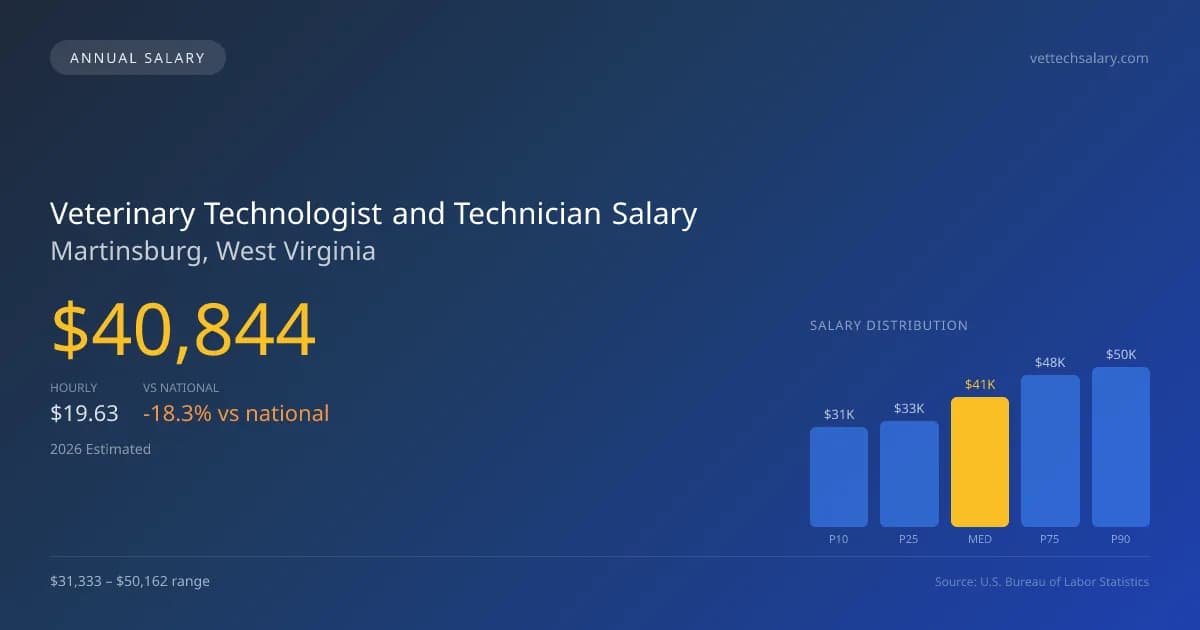
The veterinary technologist and technician salary in Martinsburg, WV, is projected to reach a median annual figure of $40,844 in 2026, reflecting a significant gap of 18.29% compared to the national median of $49,986. Local professionals can expect a salary range from $31,333 at the lower end (P10) to $50,162 at the upper end (P90), showcasing a dynamic market for those entering this field. These figures are drawn from estimates based on 2025 BLS data and adjusted for regional cost factors, highlighting the potential for growth in a city where the demand for qualified veterinary support staff remains robust. Pursuing the VTS specialty credential, particularly in areas like emergency and critical care (ECC) or anesthesia, can elevate compensation prospects, placing skilled technicians in a more lucrative bracket within the Martinsburg job market.
About the Martinsburg Market
Salary estimated from West Virginia average ($32,000) adjusted for local cost of living.
Salary Breakdown
| Percentile | Annual | Hourly |
|---|---|---|
| Entry Level (P10) | $31,333 | $15.07 |
| Lower Range (P25) | $33,381 | $16.05 |
| Median (P50)(typical) | $40,844 | $19.63 |
| Upper Range (P75) | $47,718 | $22.95 |
| Top Earners (P90) | $50,162 | $24.12 |
Median Salary Position
18.29% below the national average
2026 Salary Percentile Distribution in Martinsburg
In Martinsburg, WV, the veterinary technologist and technician salary spread from the 10th to 90th percentile is $18,829 (2026 est.). At $40,844, the local median is 18.29% below the national median of $49,986.
Salary Calculator
At 40 hours/week in Martinsburg: You'd be above the median
How Martinsburg Veterinary Technologist and Technician Pay Compares
Martinsburg median: $40,844/year (2026)
| Compared To | Median Salary | Martinsburg Pays |
|---|---|---|
| West Virginia Average | $43,222 | -5.50% less |
| National Average | $49,986 | -18.29% less |
Veterinary Technologist and Technicians in Martinsburg, WV earn a median of $40,844 per year (2026 est.), which is 18.29% lower than the national median of $49,986 and 5.50% below the West Virginia state average of $43,222.
Cost-of-Living Adjusted Salary
Martinsburg has a cost of living 13.50% below the national average, meaning your salary goes further here.
Adjusted salary = nominal × (100 / CoL index). CoL index: 100 = national average.
Martinsburg, WV has a cost-of-living index of 86.5 (below the national average of 100). A veterinary technologist and technician earning $40,844 nominally has purchasing power equivalent to $47,218 in an average-cost city — an effective 15.61% boost.
Compare Purchasing Power
Select a city to see how your salary compares after cost of living
Select a city above to compare purchasing power
2019 BLS Actual
$28,861
2025 BLS Actual
$38,715
2026 Current Est.
$40,844
2019–2027 Growth
+49.3%
Salary Trajectory for Veterinary Technologists and Technicians in Martinsburg (2019–2027)
2019–2025: actual BLS OEWS data for this metro area. 2026+: CAGR 5.50% projection.
| Year | Annual Salary | Status |
|---|---|---|
| 2019 | $28,861 | Actual |
| 2020 | $29,629 | Actual |
| 2021 | $30,111 | Actual |
| 2022 | $31,247 | Actual |
| 2023 | $35,741 | Actual |
| 2024 | $26,147 | Actual |
| 2025 | $38,715 | Actual |
| 2026(current) | $40,844 | Estimated |
| 2027 | $43,091 | Projected |
Based on 7 years of BLS OEWS data for the Martinsburg metropolitan area, the median veterinary technologist and technician salary grew 34.1% from $28,861 (2019) to $38,715 (2025). At a 5.50% compound annual growth rate, salaries are projected to reach $43,091 by 2027 — a total increase of $14,230 (49.31%) from 2019.
Note: Historical values (2019–2025) are actual BLS OEWS figures for the Martinsburg metropolitan area, sourced from annual Occupational Employment and Wage Statistics surveys. 2026–2026 figures are current estimates, and 2027 values are projections, calculated using a 5.50% CAGR derived from 7-year BLS historical data. Actual salaries may vary based on employer, experience, certifications, and local market conditions.
Salary by Experience Level
| Experience | Estimated Salary Range |
|---|---|
| 0-2 years (New Graduate) | $31,333 – $33,381 |
| 3-5 years (Mid Career) | $33,381 – $40,844 |
| 5+ years (Experienced) | $40,844 – $47,718 |
| 10+ years (Top Earner) | $47,718 – $50,162 |
Vet Tech salary ranges estimated from BLS percentile data. Individual veterinary technologist and technician compensation varies by employer, certifications, and specialization.
Veterinary Technologist and Technician Job Market in Martinsburg
In Martinsburg, the job market for veterinary technologists and technicians is relatively small, with only six professionals currently employed in the area. However, the cost of living index stands at 86.5, indicating that take-home salaries stretch further than they might in more expensive regions, providing greater purchasing power despite lower average pay. The highest salaries are typically found in specialty referral hospitals, particularly those focused on surgery, ECC, and oncology, which often offer better compensation compared to general practice settings. Various factors contribute to the pay disparity, including the impact of the VTS specialty credential, where technicians with advanced skills can command hourly wages ranging from $30 to $45 or more. Additionally, corporate veterinary chains may have structured pay scales that reward tenure and specialization differently than independent clinics. For those seeking to maximize their earnings in Martinsburg, pursuing VTS credentials, looking for positions in specialty healthcare facilities, and negotiating based on skills and specialties are practical strategies to enhance overall compensation.
More salary data for Martinsburg, WV:
Frequently Asked Questions
How much do veterinary technologists and technicians make in Martinsburg, WV in 2026?
Is Martinsburg, WV a good place to work as a veterinary technologist and technician?
Can veterinary technologists and technicians make $100K in Martinsburg?
What is the cost-of-living adjusted veterinary technologist and technician salary in Martinsburg?
How much does a veterinary technologist and technician make per hour in Martinsburg?
Related Pages
Compare Salaries
Career Resources
Nearby Cities in West Virginia
Written by Jordan Lee, CVT
Career Analyst
Jordan has 10 years of experience in veterinary technology. They specialize in emergency care. Jordan has worked in both clinic and hospital settings.
Methodology & Data Source
Salary figures on this page are 2026 projections based on the Bureau of Labor Statistics Occupational Employment and Wage Statistics (OEWS) survey, May 2026 release. The BLS reported a median annual salary of $38,715 for veterinary technologists and techniciansin the Martinsburg metropolitan area. A 5.50% compound annual growth rate (CAGR), calculated from 6-year national BLS wage trends, was applied to project current 2026 compensation. Percentile ranges (P10–P90) represent the full salary distribution across experience levels and practice settings in this market.
Data Sources & Methodology
Salary data for Martinsburg is estimated from official BLS state-level occupational wage data (2025), adjusted for regional cost-of-living differences using BEA RPP (Regional Price Parities).
2026 figures are projected from 2025 BLS data using a compound annual growth rate (CAGR) of 5.50%, derived from historical BLS wage trends for veterinary technologist and technicians (SOC 29-2056).
Compiled and verified by Jordan Lee, CVT, a licensed veterinary technologist and technician with 10+ years of clinical experience. · View source data at BLS.gov