Veterinary Technologist and Technician Hourly Pay in State College, PA: $22.80 (2026)
Quick Answer:Hourly pay for a veterinary technologist and technician working in State College, PA runs $22.80 at the median for 2026 — annualizing to $47,412 at a standard 2,080-hour year. Figures projected from BLS OEWS 2025 (SOC 29-2056). Weighted against State College's regional price level (BEA RPP 96.8, 3% below national), each hour of work buys what $23.56 nationally would. A 24-hour part-time schedule grosses $28,453 per year.
Official BLS data · View source
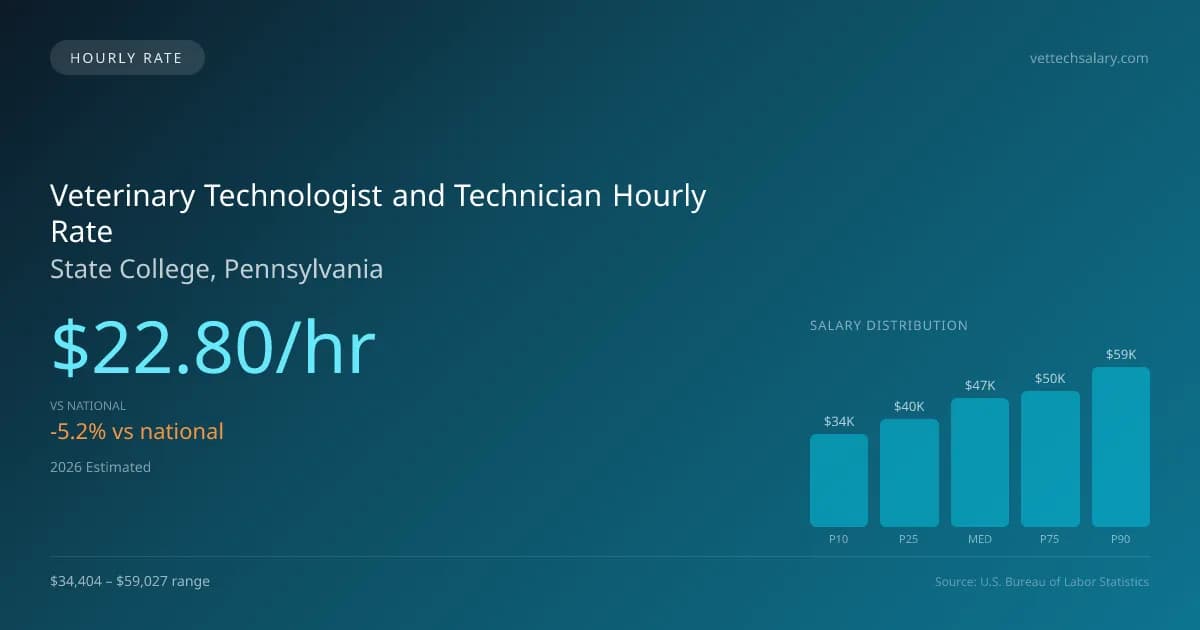
In State College, Pennsylvania, veterinary technologists and technicians earn a median hourly pay of $22.80, which falls short of the national median of $24.03. This hourly wage not only reflects the growing demand for skilled veterinary professionals but also signifies potential earnings for part-time and per-diem workers. For those working three days a week, roughly 24 hours, this hourly rate translates into a modest annual income, while per-diem workers can find opportunities in various settings like specialty hospitals or university veterinary clinics. The hourly pay range for veterinary technologists and technicians in the area spans from about $16.54 at the entry-level up to $28.38 for seasoned professionals, making it a viable option for those seeking flexible work arrangements in fields such as general practice treatment areas or pharmaceutical research facilities. According to 2025 BLS OEWS data, projected to 2026, this information serves as the basis for understanding compensation in this sector.
Veterinary Technologist and Technician Hourly Wage Breakdown
| Percentile | Hourly Rate | Per 8hr Shift |
|---|---|---|
| Entry Level (P10) | $16.54 | $132.34 |
| Lower Range (P25) | $19.22 | $153.78 |
| Median (P50) | $22.80 | $182.39 |
| Upper Range (P75) | $24.15 | $193.19 |
| Top Earners (P90) | $28.38 | $227.04 |
Estimated Annual Income by Work Schedule in State College
Based on $22.80/hr median hourly rate · 2026 est.
At $22.80/hr, a veterinary technologist and technician working full-time (40 hr/wk) in State College, PA can expect to earn approximately $47,421 per year (2026 est.). Part-time hygienists working 24 hours per week would earn around $27,358. With a cost-of-living index of 96.76 (below the national average), these earnings stretch further in State College.
Hourly Rate Calculator
Schedule Comparison in State College
| Schedule | Weekly | Monthly | Annual |
|---|---|---|---|
| Full-Time (40 hrs) | $911.94 | $3,952 | $47,421 |
| Part-Time (24 hrs) | $547.17 | $2,371 | $28,453 |
| Per Diem (16 hrs) | $364.78 | $1,581 | $18,968 |
Compare Vet Tech Wages With Similar Roles
| Role | Median Hourly |
|---|---|
| Veterinary Technologist and Technician (State College) | $22.80 |
| Veterinary Assistant (National Avg) | $17.99 |
| Veterinarian (National Avg) | $60.38 |
| Animal Care and Service Worker (National Avg) | $15.87 |
| Medical Lab Technician (National Avg) | $28.18 |
Veterinary Technologist and Technicians in State College, PA earn a median of $47,412 per year (2026 est.), which is 5.15% lower than the national median of $49,986 and 0.20% below the Pennsylvania state average of $47,507.
Veterinary Technologist and Technician Hourly Pay vs. Cost of Living
Working 24h/week at $22.80/hr = $28,453/year (purchasing power: $29,405).
Working 40h/week (full-time) = $47,421/year (purchasing power: $49,008).
CoL index: 96.762 (100 = national average). Your dollars stretch further here.
2019 BLS Actual
$15.96/hr
2025 BLS Actual
$21.61/hr
2026 Current Est.
$22.80/hr
2019–2027 Growth
+50.7%
Hourly Rate Trajectory for Veterinary Technologists and Technicians in State College (2019–2027)
2019–2025: actual BLS OEWS data for this metro area. 2026+: CAGR 5.50% projection.
| Year | Hourly Rate | Status |
|---|---|---|
| 2019 | $15.96/hr | Actual |
| 2020 | $16.34/hr | Actual |
| 2021 | $17.44/hr | Actual |
| 2022 | $17.44/hr | Actual |
| 2023 | $18.21/hr | Actual |
| 2024 | $18.98/hr | Actual |
| 2025 | $21.61/hr | Actual |
| 2026(current) | $22.80/hr | Estimated |
| 2027 | $24.05/hr | Projected |
Based on 7 years of BLS OEWS metropolitan area data, the median hourly rate for veterinary technologists and technicians in State College grew 35.4% from $15.96/hr (2019) to $21.61/hr (2025). At a 5.50% projected growth rate, hourly pay is expected to reach $24.05/hr by 2027. Part-time and per-diem veterinary technologists and technicians can use this multi-year trend to benchmark future contract negotiations.
Note: Historical values (2019–2025) are actual BLS OEWS figures for the State College metropolitan area, sourced from annual Occupational Employment and Wage Statistics surveys. 2026–2026 figures are current estimates, and 2027 values are projections, calculated using a 5.50% CAGR derived from 7-year BLS historical data. Actual salaries may vary based on employer, experience, certifications, and local market conditions.
Working as an Hourly Veterinary Technologist and Technician in State College
Part-time veterinary technologists and technicians working in State College typically take home less than their full-time counterparts, with earnings significantly dependent on their weekly hours. A three-day workweek would yield an approximate annual take-home that is substantially lower than full time, given that many full-time positions come with benefits that can elevate overall compensation. On the per-diem front, these professionals can command rates that vary dramatically; for instance, per diem vet techs frequently bill anywhere from $25 to $40 per hour, while specialty certified technicians may achieve pay rates between $35 and $55 hourly. Additionally, higher demand during weekends or overnight shifts often sees rates soar to $30-$50 per hour, especially in understaffed emergency facilities. It’s noteworthy that salary expectations can differ substantially depending on the type of employer—general practice clinics, corporate chains, specialty hospitals, or research facilities—all of which might present different hourly pay structures. Veterinary technologists and technicians navigating these options might find it beneficial to weigh the advantages of higher hourly rates against the supported benefits that come with traditional employment. Understanding the local market dynamics in State College can aid in effectively negotiating compensation in this evolving field.
More salary data for State College, PA:
Frequently Asked Questions
What is the hourly rate for veterinary technologists and technicians in State College in 2026?
How much do part-time veterinary technologists and technicians make in State College?
Are veterinary technologists and technicians in State College paid hourly or salary?
How much does a full-time veterinary technologist and technician make per year in State College?
Do veterinary technologists and technicians earn more per hour working part-time in State College?
Related Pages
Compare Salaries
Career Resources
Nearby Cities in Pennsylvania
Written by Jordan Lee, CVT
Career Analyst
Jordan has 10 years of experience in veterinary technology. They specialize in emergency care. Jordan has worked in both clinic and hospital settings.
Methodology & Data Source
Hourly wage figures on this page are 2026 projections based on the Bureau of Labor Statistics Occupational Employment and Wage Statistics (OEWS) survey, May 2026 release. A 5.50% compound annual growth rate (CAGR), derived from 6-year national BLS wage trends, was applied to estimate current 2026 hourly rates for veterinary technologists and technicians in State College. Part-time and full-time income estimates assume consistent weekly hours and do not account for overtime, benefits, or seasonal variation.
Data Sources & Methodology
Source: BLS, OEWS, 6-year dataset (–). Per-city data from annual BLS metropolitan area surveys.
2026 figures are projected from 2025 BLS data using a compound annual growth rate (CAGR) of 5.50%, derived from historical BLS wage trends for veterinary technologist and technicians (SOC 29-2056).
Compiled and verified by Jordan Lee, CVT, a licensed veterinary technologist and technician with 10+ years of clinical experience. · View source data at BLS.gov